


If you’re using agents, you generate a lot of data. Lots and lots of data.
Data that reflects how something was built, reflects inquisitive queries, and reflects how people interface with new emerging AI systems. In the last few months, our small team has generated several hundred GBs of AI trace data captured through our platform from building our products. All this data flows through tapes, our free and open source system for capturing, managing, and deriving value from AI trace data.
But we quickly realized that having a single, monolithic approach to
capturing and handling our user’s AI traces would not be enough in this new,
emerging world of custom bespoke software and agents.
Your personal use case for querying and connecting your AI trace data may be very different from
how an enterprise at scale would need to manage it.
Our users need a way to deploy the tapes stack however they want,
connect arbitrary capabilities to the tapes APIs, and plug the data into their existing tooling.
We needed to create the building blocks for how AI data at scale is handled, and, in doing so,
we unlocked an entire ecosystem of tooling and functionality.
Today, we are releasing the tapes stack as a dual licensed, Apache/MIT project and introducing
cassettes,
a powerful building-block-integration paradigm for connecting, kneading, and building with tapes.
We deeply believe that, in the age of AI, the data that surrounds your agents is one of the most powerful
levers you have. And you should be free to query that data how you want, build on top of that
data how you want, and shape the data how you want. Cassettes give you that capability,
shared across a common /v1/cassettes/ API namespace in tapes, all powered by open standards and OpenAPI.
On the client side, we built a new Rust based tapesctl client, that incorporates several of our open source Rust crates that mirror how we handle client interactions on the Paper Compute Co. platform gateways:
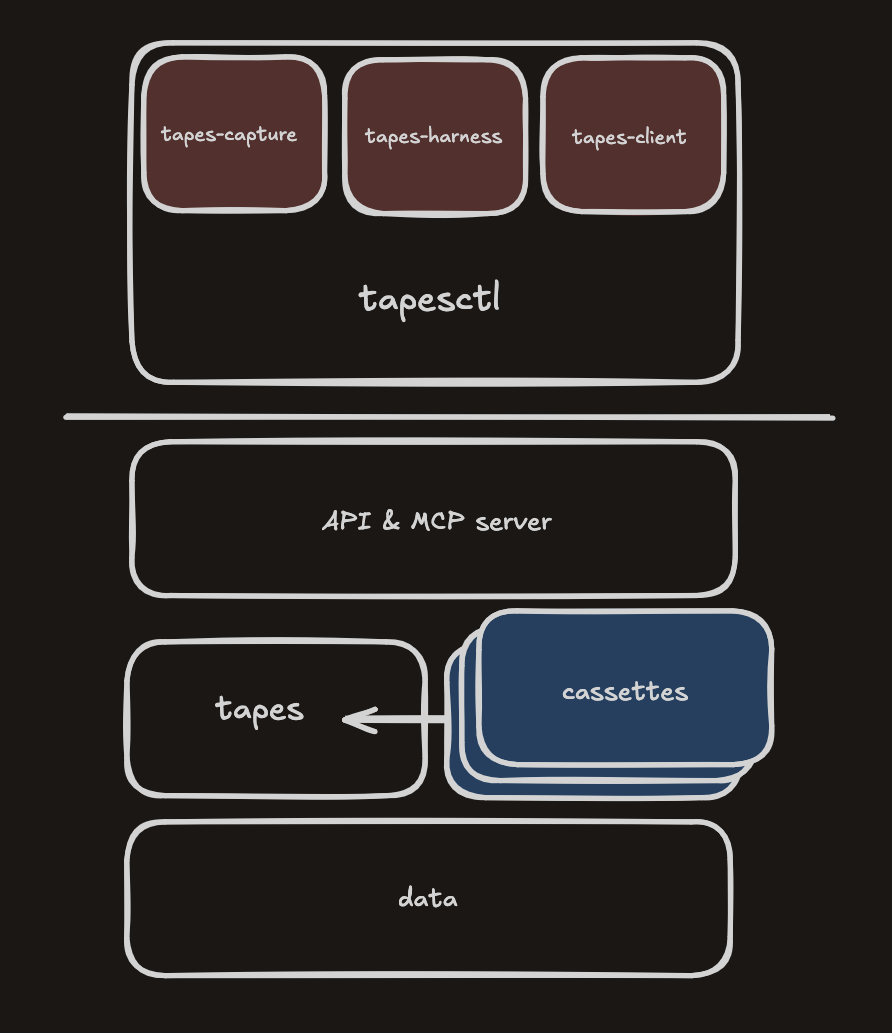
tapes open core architectureOn the server side, tapes now aggregates configured cassette APIs. These run alongside
a tapes server as microservices in order to serve those capabilities on one single unified interface.
This allows our clients (like tapesctl and the Paper console) to automatically discover new AI data capabilities
directly from the server.
One of our first proof-of-concept use cases for this new cassettes paradigm was building bespoke capabilities
for an OpenClaw integration for evaluating skill improvements. OpenClaw’s new skill_proposal_evaluate lifecycle hook
allows an autonomous agent to evaluate a proposed enhanced skill change before it’s applied.
We built a skills-evaluation-cassette that looks at how that skill performed in real past sessions with real trace session data, weighs the evidence, and returns feedback on the proposed change along with suggestions for improving it.
Instead of judging the proposal without context, the agent can use evidence from what worked before, what didn’t, and what changed. This approach grounds a non-deterministic autonomous agent in real-world evidence for greater impact.
We’ve also aligned all the core tapes functionalities around cassettes:
search,
export,
and skills
are now open-core cassettes that can be run alongside the tapes server in any configuration you need.
This gives you the power, flexibility, and freedom to run tapes how you want.
Give it a try today: you can run tapes yourself locally,
start capturing and storing your agent trace data,
and build your own Cassette to run alongside tapes
to unleash anything you can imagine.
We’re providing the platform tooling to make open and free AI data a reality and we’re very excited to see what you build!
Start with paper
Turn every session into knowledge at team scale.