

Definition
AI platform engineering is the discipline of running AI tools across an enterprise as a governed platform — with shared inference, shared telemetry, shared policy, and shared cost accounting — often operated by platform engineering, developer infrastructure, ML platform, or security engineering teams.
AI platform engineering often starts with the teams that already run the company’s API gateway, identity platform, developer platform, ML platform, or security infrastructure, because the shape of the problem is familiar: a primitive showed up, three teams adopted it ad hoc, and governance pressure is now forcing consolidation. AI is becoming another platform layer. In many organizations, platform engineers are already being pulled into it, whether or not the work has a formal owner yet.
This page is the reference for the role: what AI platform engineering is, where it sits historically, what it owns, what tools it uses, how it relates to InfoSec and FinOps, and the four-stage maturity model that describes where most organizations actually are right now.
What AI platform engineering is responsible for
| Responsibility | What it covers |
|---|---|
| Inference | The shared path AI traffic takes out of the box — provider routing, model selection, fallbacks. |
| Gateway | The single network chokepoint where capture, policy, and audit happen. The primary artifact. |
| Capture | A durable archive of prompts, responses, and tool calls across approved, routed, or gateway-connected AI tools. |
| Policy | Per-team / per-model / per-data-class rules — what is allowed, what is blocked, what is redacted. |
| Cost | Token-level cost allocation by team, project, and provider, integrated into the existing FinOps stack. |
| Governance | Retention, audit, redaction, incident response — the workflow layer InfoSec and Legal depend on. |
How AI platform engineering follows the SSO and service mesh pattern
Many platform engineering functions emerge because a successful primitive outgrows the team that adopted it first. Authentication in the 2000s was a per-app problem — every internal app had its own login form and its own user table. By the mid-2010s, many organizations had learned that maintaining separate auth systems across internal apps was more expensive and riskier than centralizing identity. Identity became a platform responsibility. The pattern has repeated for containers (orchestration platforms), microservices (service meshes), and cloud spend (FinOps). A primitive arrives, teams adopt ad hoc, governance forces consolidation, a platform team is born. AI tools are running the same arc on a faster clock.
A single engineer’s AI work over ten days can produce hundreds of sessions, millions of prompt tokens, and multiple model tiers. The shape of that data — volume, cost distribution, tool mix — is what platform engineering operates on.
AI platform engineering is compressing faster than earlier platform shifts. The side-door problem — engineers using personal API keys, unmanaged chat tools, and agents calling provider endpoints from laptops — is no longer theoretical. Governance pressure is arriving earlier because the questions are sharper: where is company data going, who approved the model, what did it cost, and can we reconstruct what happened?
The shape is familiar, but two things are unique to AI. First, the side door is open at every workstation, not at a server in a controlled environment — engineers paste prompts into chat tabs from laptops, agents call providers from any directory. Second, the volume is high enough that no human can review traffic after the fact: a single engineer’s AI work over ten days can produce millions of prompt tokens. The platform must be the review surface, because no human will be.
For the deeper context on the artifact this team is responsible for, see enterprise AI gateway. For the data-plane mechanism, see LLM proxy.
The mandate is bigger than any individual primitive in it. The gateway is the load-bearing artifact, but the team also owns the configuration of which models are approved for which data classes, the cost-allocation reports finance reads quarterly, the retention policy that satisfies legal, and the on-call rotation that fields incident-response questions about agent behavior. The novel part is not the shape — it’s the payload: prompt-and-response data instead of API calls or auth tokens.
What the AI platform engineering stack looks like
The AI platform stack is not a single product. It’s a layered system, with each layer owning a specific responsibility and integrating with the existing platform stack underneath. The good news for platform teams is that the layers compose cleanly — you can adopt them one at a time, replace any single layer without rewriting the others, and use existing tools (the FinOps platform, the observability stack, the policy engine) where they fit. The bad news is that the layers are non-negotiable: skipping any one of them is what produces the second-system rebuild that catches most teams.
A real implementation usually combines a proxy or gateway, a structured capture store, a policy engine, cost-allocation mappings, and existing security/compliance workflows.
The five layers, bottom to top:
Inference layer
The runtime path AI requests take. In 2026, many enterprise AI requests still flow to SaaS providers — OpenAI, Anthropic, Google — alongside a growing mix of self-hosted and local models. The platform team’s job at this layer is provider selection, fallback policy, and the narrow case where requests need to run inside a controlled environment (see stereOS for hardened runtime for agents).
Capture layer
The proxy and the archive it writes to — a process on the laptop or the server, intercepting routed AI requests, writing a structured row, and forwarding upstream. Every layer above depends on what capture records.
Policy layer
The enforcement point that decides what’s allowed and what’s blocked. Per-team rules, per-model allow-lists, per-data-class redaction. Most platform teams build this on top of an existing policy engine (Open Policy Agent is common) wired into the gateway’s request path.
Cost layer
The integration that turns captured token counts into dollar figures attributable to a team and project. This is usually a thin layer on top of the existing FinOps platform — a CSV export from the capture archive, mapped to chargeback codes, fed into the same dashboards finance already uses for cloud spend.
Governance layer
The workflow tier on top: retention policy, audit trail export, redaction rules, incident response runbooks. This is where the platform team’s work becomes legible to InfoSec, Legal, and Compliance. The other layers produce the data; the governance layer is how the rest of the company consumes it.
When a chat tab runs out of context or an agent session is closed, the work is gone unless something captured it. Capture is the layer that survives every other failure mode.
A specific 2026 stack for a platform team starting from zero looks like: an open-source capture proxy for the capture layer, Open Policy Agent (or an existing policy engine) wired into the proxy for the policy layer, the existing FinOps platform for cost, and the existing audit/compliance tooling for governance. The integration work is real but bounded.
How AI platform engineering fits in the org chart
The cleanest way to draw the org chart is to think about which team can answer which question. AI platform engineering owns the gateway and the capture archive, and through them, the answers to “what AI traffic exists” and “what is the platform-level cost.” InfoSec owns the questions about whether traffic is allowed, what egress destinations are permitted, and whether sensitive data has left the trust boundary. FinOps owns chargeback and budget. Individual engineering teams own which models they use for what — within the policy bounds the platform team enforces.
| Team | Owns | Does NOT own |
|---|---|---|
| AI platform engineering | The gateway. The capture archive. The platform-level cost and telemetry. The runtime path. | Per-team policy decisions. Specific data classifications. Application-level model selection. |
| InfoSec | Egress policy. Data classification. Audit requirements. Incident response requirements. | Day-to-day gateway operation, unless the gateway sits inside security engineering. |
| FinOps | Chargeback codes. Budget allocation. Cost reporting to leadership. | Per-team policy. The technical infrastructure the cost data comes from. |
| Individual engineering teams | Which AI tools they adopt within policy. Which models for which application. The agent code. | The gateway. The cost rules. The retention policy. |
| Legal / Compliance | Retention policy. Data residency rules. Contractual constraints with providers. | The technical implementation. |
The common conflict patterns are predictable. InfoSec wants stricter egress rules than engineering teams find tolerable; the gateway is where that tension gets negotiated, with platform engineering as the operator. FinOps wants per-project cost attribution that the platform team has to produce from token counts; the cost layer is where that translation happens. Engineering teams want freedom to adopt new models without going through review; the policy layer is where the friction lives. None of this is novel for a platform team. It’s the same negotiation pattern as service mesh, identity, or any other shared platform, but the cycle time is faster because AI tooling moves faster than the underlying platform layers did.
A common adoption pattern: the AI platform team is stood up first as a virtual team, drawn from the existing platform engineering org with a dotted line to InfoSec. As the gateway moves from pilot to company-wide, the virtual team becomes a real one, and the dotted line becomes a quarterly review with InfoSec, FinOps, and Legal. The platform team operates the gateway day-to-day; the other three teams set policy that the gateway enforces.
Four maturity levels of AI platform engineering
Most organizations are not at the level they think they are. The four-stage maturity model maps where AI platform engineering actually is at a company — based on what the platform team can answer, not on how many AI tools are deployed.
Stage 1 — Ad hoc
├── No gateway. No capture. Personal API keys.
├── "How much did we spend on AI last quarter?" → corporate card statement
└── "What did the agent do during that incident?" → the chat tab is closed

Stage 2 — Captured
├── Gateway running in shadow mode. Every request archived.
├── "How much did we spend?" → real numbers, by team, by model
└── "What did the agent do?" → replayable archive

Stage 3 — Governed
├── Policy enforced. Egress allow-listed. Retention defined.
├── "Is this prompt allowed?" → the gateway answers
└── "Can we produce records for this audit?" → yes

Stage 4 — Self-improving
├── Captured sessions become skills, runbooks, and more.
├── Skills, evals, runbooks, retrieval corpora, and fine-tuning datasets.
└── The dataset compounds; new agents start ahead of where old ones did.
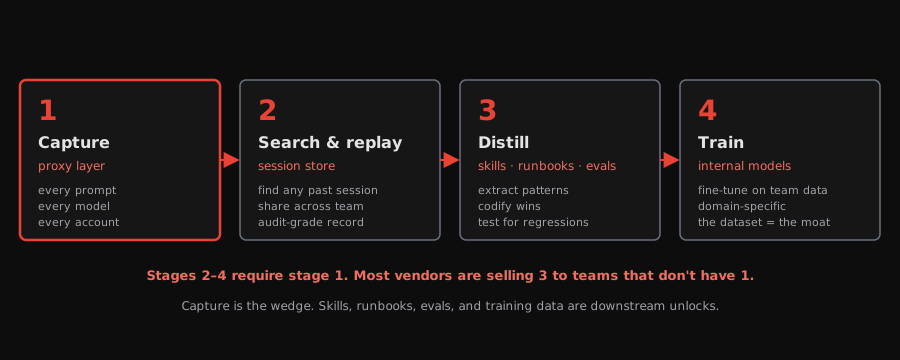
Many companies under 200 engineers in early 2026 are still at stage 1, especially if AI adoption started through individual tools rather than a formal platform program. The first finance question or first incident is usually what tips a company into stage 2, often as a panic project to “find out where the data is going.” Many enterprises starting their AI platform journey in 2026 try to land at stage 2 first, because capture is the prerequisite for cost reporting, replay, policy, and audit.
Stage 3 is where many companies plateau and that’s a reasonable place to stop. The gateway works, governance is real, costs are managed. Stage 4 is where the platform stops being a cost center and becomes a data asset, but not every organization needs to get there.
When a chat tab runs out of context, the AI tool often generates a conversation summary to continue. A capture archive preserves both the summary and the underlying detail. Stage 4 needs both.
The maturity model is a diagnostic, not a roadmap. The right stage depends on how central AI is to the business — what matters is knowing where you actually are and where you need to be.
How Paper Compute supports AI platform engineering teams
paper console provisions and manages tapes AI gateways — shared inference endpoints with durable session capture built in. Each gateway runs an Envoy AI Gateway instance backed by a tapes store, so every prompt, response, and tool call is captured automatically. Backends scope which models are reachable and which provider credentials to use, giving platform teams model allowlisting and flexible auth at the edge.
For AI platform engineering, paper covers the capture and inference layers described above: a team provisions a gateway, attaches the providers they approve, and points their agents at it. The capture archive is the substrate for cost reporting, replay, audit, and the downstream stages in the maturity model. stereOS covers the narrow case where the inference layer needs a hardened runtime.
paper is currently in development. Sign up for the waitlist to get early access. For the companion artifact view, read enterprise AI gateway; the two pages are designed to be read together.