

Definition
An enterprise AI gateway is an AI gateway operated as shared company infrastructure. Instead of one developer or team running it, the organization relies on it to manage AI traffic across teams, tools, models, budgets, and security requirements. That shift adds per-team policy, a central archive, cost allocation, audit workflows, and an operating team to the core gateway.
An enterprise AI gateway is what happens when an AI gateway becomes shared company infrastructure. Instead of one developer or team running it, the organization relies on it to manage AI traffic across teams, tools, models, budgets, and security requirements. Running a proxy is a technical task; running an enterprise gateway is a platform responsibility, with owners, a runbook, and other teams depending on it.
The pillar teaches what the architecture is. This page teaches what it takes to operate it: the capabilities the organization needs, whether to build or buy them, and how to roll the gateway out without making it a company-wide dependency on day one.
A note on the name. This deployment is sometimes called an “enterprise inference gateway.” We avoid that phrasing because inference gateway means something narrower in Kubernetes: infrastructure for routing requests to self-hosted models. The pillar’s taxonomy covers the distinction; this page uses enterprise AI gateway throughout.
What an enterprise deployment adds to the AI gateway pattern
At organization scale, the gateway stops being a process someone runs and becomes infrastructure a team operates, and the capability list grows with it. The first four capabilities below are common across most serious gateway deployments. The last two are differentiators. Many gateway products stop at metadata logging, so if you need high-fidelity replay of captured exchanges or tamper-evident audit records, verify they exist instead of assuming them.
| Capture | Requests, responses, and the tool-call messages that cross the provider connection from gateway-connected tools, written to a durable archive. |
|---|---|
| Policy | Per-team, per-model, per-data-class rules enforced before the prompt leaves the company network. |
| Egress | Which destinations traffic may leave the network for: allow lists, logging, and redaction of sensitive payloads. |
| Telemetry | Cost per team, per model, per project. Latency and token throughput in one place. |
| Replay & search | Differentiator: a queryable archive of captured model exchanges, so the platform team can replay what crossed the gateway during a session. Many products log metadata only. |
| Audit | Differentiator: tamper-evident records with retention controls and access logging. Verify this exists rather than assuming a log satisfies it. |
Two caveats keep this list honest. First, the gateway sees what crosses the provider connection. It does not see what an agent runs locally or the side effects on the machine, so read “captures every tool call” as “captures every tool-call message in provider traffic.” The same boundary defines replay: a gateway archive supports gateway-visible replay (requests, responses, tool-call messages, routing decisions, metadata). Reconstructing complete agent execution, including local commands and environment state, requires capture beyond the gateway request path and is a separate capability. Second, full payload capture is what makes gateway-visible replay and audit possible; lighter metadata capture may be enough for routing, budgets, and some policy. Decide which tier you need first, because it drives the build-vs-buy analysis below.
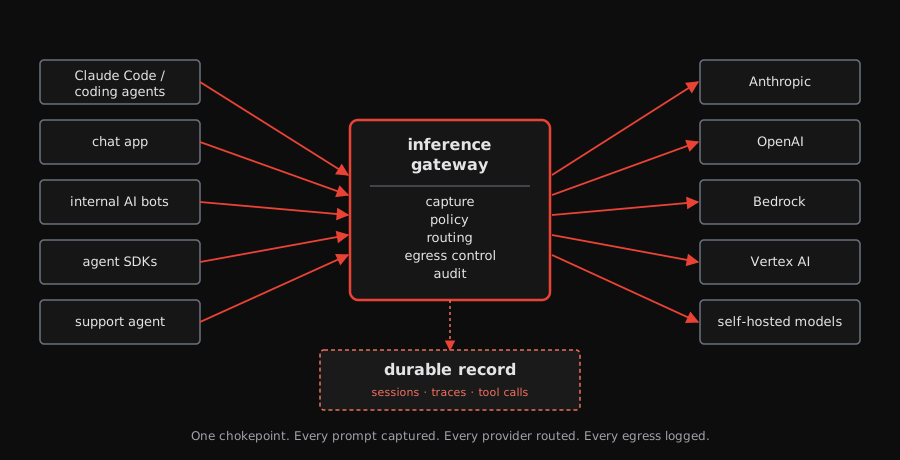
The capabilities stack. Capture comes first. Policy and egress enforce rules on top of what capture sees. Telemetry, replay, and audit all read from the capture archive. If the layers stay clean, replacing any one of them (swapping a policy engine, changing the storage backend, adding a new destination rule) is a contained change.
A team of 50 engineers each running 5 hours of AI work a day could generate 250 sessions a day, in 5+ different tools, against 3+ models. Fragments of that record exist in provider dashboards and per-tool logs. No single governed view holds it.
How to decide whether to build or buy an enterprise AI gateway
The build-vs-buy decision is genuinely open; the category is young enough that several paths are reasonable. A common internal path starts with a lightweight proxy or logging shim on a shared host. That can prove the value quickly: real usage numbers in front of finance and security within weeks. The hard part arrives when additional teams bring different policies, retention requirements, uptime expectations, and audit needs, and the flat log cannot answer for them. That is the moment the real system gets scoped, and where build vs buy gets decided.
The v2 conversation deserves a real decision matrix rather than a vendor checklist. Eight dimensions do most of the work:
| Dimension | Favors building | Favors buying |
|---|---|---|
| Engineering ownership | A platform team exists with capacity to own a production service indefinitely | No standing platform team; the gateway would be a side project |
| Protocol churn | You already track provider API changes for other reasons | Every new provider, endpoint version, and agent SDK becomes your maintenance task |
| Compliance scope | Requirements are unusual enough that no product maps to them | A vendor already holds the certifications your auditors ask for |
| Data residency | Records must stay inside your boundary; self-hosting is mandatory anyway | A vendor offers in-region or in-VPC deployment that satisfies legal |
| Failure isolation | You need to control the blast radius when the gateway breaks, including bypass behavior | You accept vendor SLAs and their incident process for a path all AI traffic depends on |
| Storage economics | You can operate the archive (full payloads grow fast) on existing storage infrastructure | Archive scaling, retention tiers, and query performance are problems you would rather pay for |
| Operational burden | Runbook, on-call, upgrades, and capacity reviews fold into an existing platform rotation | The team cannot staff another 24/7 service |
| Exit cost | Owning the schema and config outright matters more than time to deploy | The vendor offers portable archives and config export you have actually tested |
Three paths fall out of the matrix:
- Build the whole thing when ownership, compliance, and residency all point inward and the headcount is real. It works, and it is a multi-quarter project that ages with every provider change.
- Buy turnkey when speed matters more than extensibility and you can accept records living on someone else’s infrastructure. For regulated industries this often fails on egress alone.
- Adopt an open-source data plane and build on it. The LLM proxy page covers what that primitive does and does not do. Your effort goes into the parts that are genuinely yours: policy, cost allocation, the finance and security surfaces, and integrations with the rest of the platform.
How to roll out an enterprise AI gateway in three phases
A practical rollout can happen in three phases. Each phase has a concrete deliverable and is short enough to ship inside a quarter, and each builds on the last: phase 2 on phase 1’s data, phase 3 on phase 2’s tooling. Jumping straight to company-wide enforcement carries more organizational and technical risk; a staged rollout validates capture, policy, and operational ownership before the gateway becomes a critical dependency.
Phase 1: Single-laptop pilot
├── Install a capture proxy on one platform engineer's laptop
├── Point one AI tool at the proxy
├── Let it run for one week
└── Export the captured sessions to JSON or a local database

Phase 2: Team rollout
├── Deploy the proxy on every laptop in one volunteer team
├── Centralize exports nightly to a shared store
├── Build the first dashboard (cost per team, per model)
└── Add the first policy (allowed-models list)

Phase 3: Company-wide
├── Make the gateway the default network path for AI traffic
├── Add per-team policy, egress allow-list, redaction rules
├── Wire telemetry into the existing FinOps and observability stack
└── Establish retention and audit workflow with InfoSec / Legal
Phase 1: single-laptop pilot. One platform engineer installs a capture proxy on their own laptop and runs it for a week. The deliverable is a session export that demonstrates what the gateway captures: how many requests, against which models, with what cost shape. The point is to put real numbers in front of finance and security inside two weeks.
Phase 2: team rollout. Deploy the proxy across one volunteer team. The deliverable is the first dashboard a non-engineer can read: cost per team, per model, per project. This is also the phase where the first policy gets written (usually an allowed-models list) and the first cost-allocation report goes to finance. The team is small enough to handle exceptions manually and large enough to surface real cross-tool patterns.
Phase 3: company-wide. The gateway becomes the default network path for AI traffic, using the coverage mechanisms the pillar describes: credential custody, endpoint configuration, and egress controls. Per-team policy is in place, redaction covers the data classes legal cares about, telemetry feeds the existing FinOps and observability stack, and retention is agreed with InfoSec and Legal. At this point the platform team operates the gateway the way they operate any other shared platform: with a runbook, an on-call rotation, and a quarterly capacity review.
Cross-tool capture is the property that makes this rollout cheap. Any AI tool that can point at the gateway and speaks a supported provider protocol (a base URL setting, proxy settings, or an endpoint that looks like the provider’s own API) gets captured without a custom integration.
A durable capture archive can also become input to higher-level systems: evaluations, skill extraction, runbooks, and shared organizational knowledge. None of those come free with a gateway. They are separate systems that read the archive, and what they can learn depends on the quality of what was captured, which is why the archive is worth getting right first. For the team whose mandate this falls under, see AI platform engineering: this page is the artifact, that one is the team.